November 1, 2025
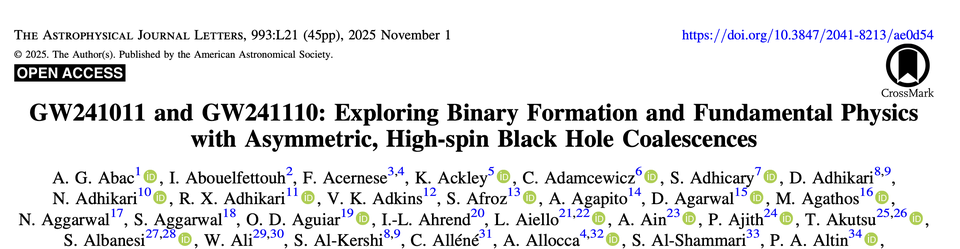
Now published: LVK paper on black holes with remarkable spins
I’m thrilled to announce the publication of a full-collaboration paper I principally authored, describing a pair of binary black holes, GW241011 and GW241110, with remarkable spin properties.
These two binaries are mirror images of one another, both in their names and in their spin properties.
GW241011 possesses one of the most rapid and aligned black holes observed to date, whereas GW241110 is among the first events to exhibit an “upside down” black hole spinning counter to its orbit.
 September 1, 2025
Hello from Williams College
I’m thrilled to be starting a new job at Williams College, where I am now an Assistant Professor of Astronomy.
Beginning this fall, I will be developing and teaching a new course on gravitational-wave astronomy, and I’m looking for enthusiastic students to get involved in gravitational-wave research!
 June 10, 2024
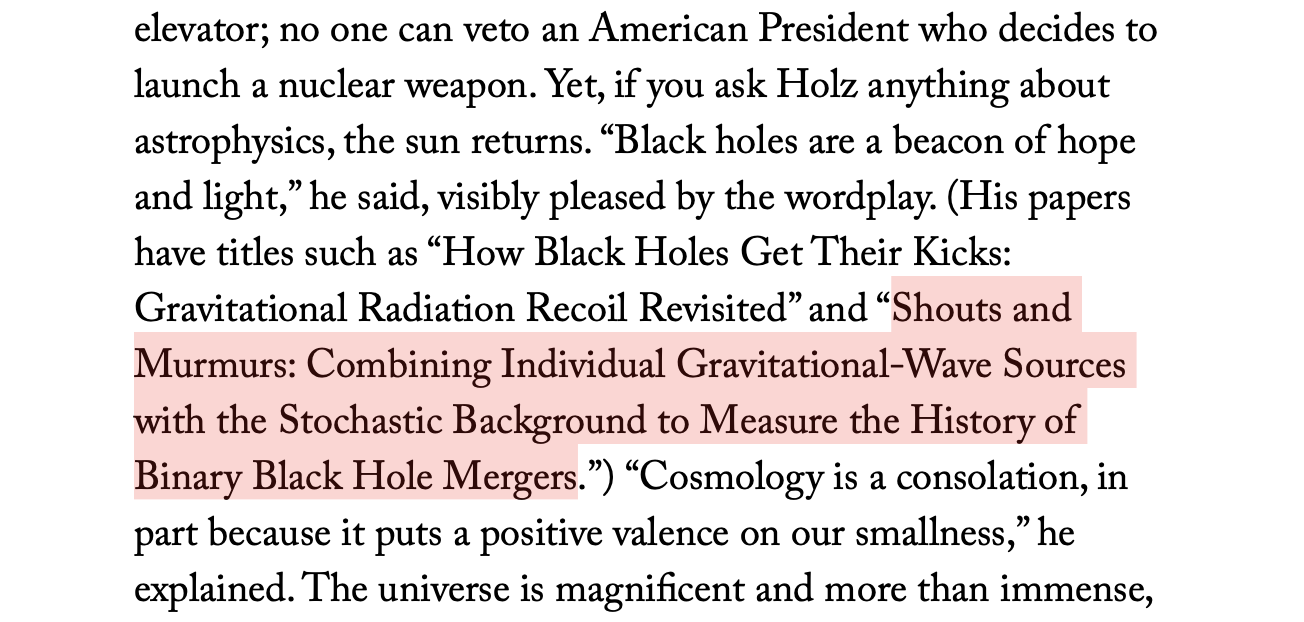
“Shouts & Murmurs” shoutout in the New Yorker
The most recent New Yorker featured an article about my collaborator (and current boss!) Daniel Holz and his work thinking about existential risk and humanity’s possible imminent doom.
In the midst of all of this appeared a quick shoutout to our paper from a few years ago, titled (appropriately for the publication in question): Shouts and Murmurs: Combining Individual Gravitational-Wave Sources with the Stochastic Background to Measure the History of Binary Black Hole Mergers.
 April 9, 2024
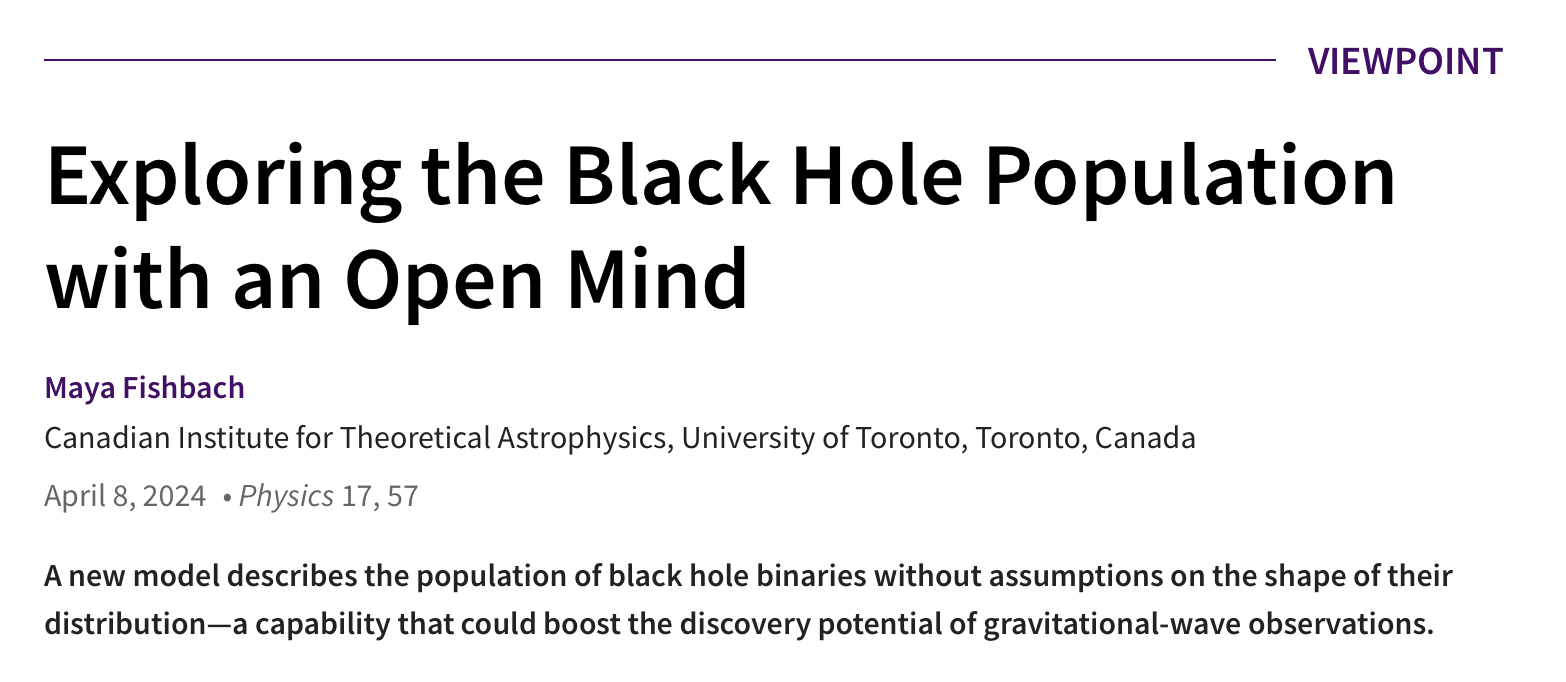
Featured in Physics Magazine Viewpoint
My recent paper with Will was featured in Physics Magazine, with a wonderful “Viewpoint” article written by Maya Fishbach.
In her article, Maya pedagogically lays out the methodological differences between traditional parametric vs. “non-parametric” models and describes some highlights from our own work.
Thank you, Maya!
 April 8, 2024
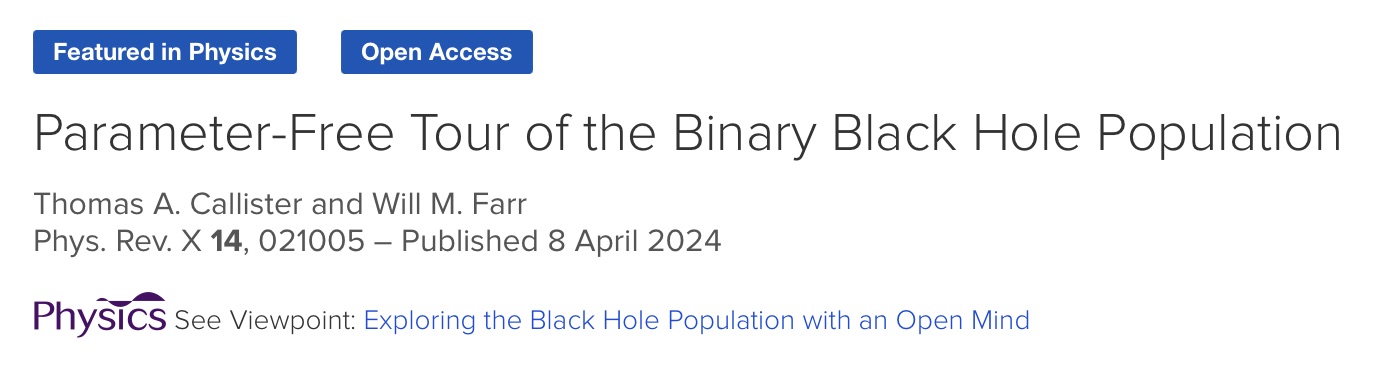
Non-parametric BBH populations paper in PRX
At long last, this paper has been published in PRX!
Will and I measure the black hole population using an autoregressive process model for the black hole merger rate (this involves doing hierarchical inference with hundreds of thousands of free parameters), checking the robustness of known features and finding fun new ones.
This paper was flagged as a “Featured” article.